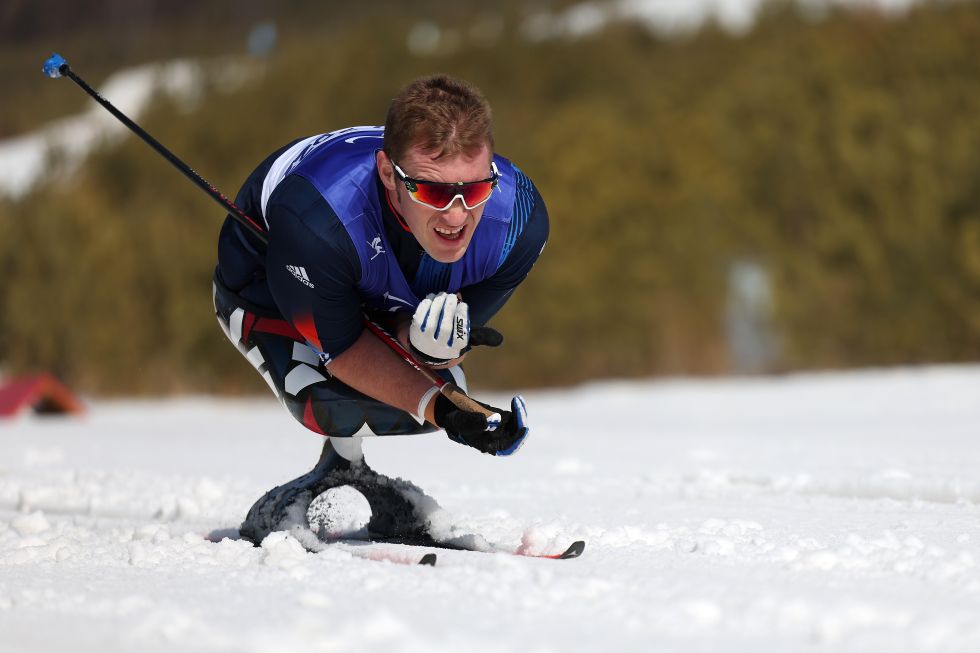
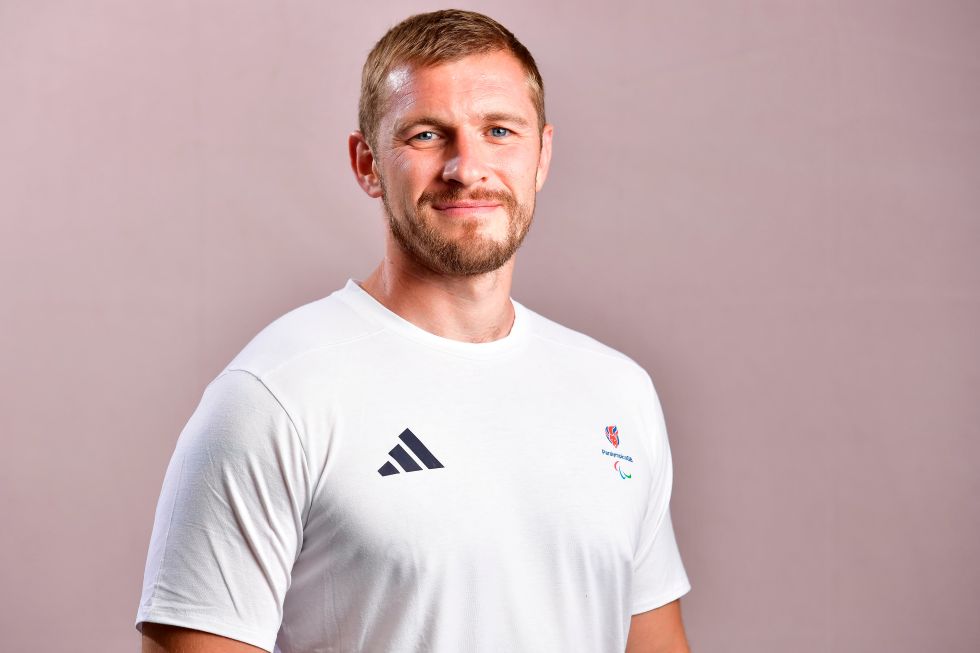
Scott Meenagh will be competing at his third Winter Paralympics in the upcoming Milano Cortina Winter Paralympic Games, something that would have seemed unfathomable after only starting Para Nordic skiing in his mid-twenties.
His efforts to make his third Winter Games appearance a memorable one, is being aided by cutting edge technology at the sportscotland institute of sport.
But the idea of spending over a decade at the highest level of a winter sport couldn’t have been further from Scott’s mind in 2011 when he was serving in Afghanistan. However, Scott’s world was turned upside down when he stepped on an improvised explosive device (IED), leaving Scott with life changing injuries, and as a result, a gruelling rehabilitation process.
 Throughout this journey, Scott was introduced to the notion of Para Sports.
Being the keen athlete that he was, he gave it a go. Going on to have an incredibly successful Para Rowing career, captaining the British Armed Forces rowing team at the 2014 Invictus Games, where they managed to take home two silver medals.
At the 2014 Winter Paralympic Games in Sochi Scott had been invited on to ParalympicsGB’s Paralympic Inclusion Programme. An initiative that provides aspiring athletes with an opportunity to witness and experience the Paralympic games in full flow. His invitation onto the programme was as a result of his impressive rowing CV.
Breaking barriers
After encountering the sport in Sochi 2014, Scott was keen to pursue a career in Para Nordic Skiing and Para Biathlon, however, there was a significant barrier to this happening, as at the time there wasn’t a UK based programme.
This may have stopped other athletes from following a career in the sport, but not Scott. He wasn’t fazed, as he had his mind firmly made up “I had to reach out to coaches in Canada and USA. I was basically cold calling coaches across the world, to see if they would be willing to show me the ropes.” Scott said.
Scott started competing in Para Nordic Skiing full time in March 2016. All of his hard work came to fruition, as he made a name for himself on the circuit, representing Paralympics GB, at both the PyeongChang 2018 and Beijing 2022 Winter Paralympics.
Finishing 6th in the 12.5km Individual Biathlon race in the latter. Scott’s career continued to go from strength to strength, becoming the first British athlete to win a Para Nordic World Championship medal, as he took home silver from Ostersund, Sweden.
Scott reflected on his journey in the sport commenting: “At the start to think that I would be going to one Paralympics would have been a miracle. So, to be staring down the barrel of my third is something that I am very proud of.”
For any athlete, Scott’s choice of Paralympic sport was a particularly bold one given the degree of difficulty involved. The physical demands of Nordic Skiing are extreme, while Biathlon is notorious for the added shooting element which requires athletes to immediately transition from high intensity skiing to shooting, which is best performed with a low heart rate. Penalties for missed shots are high, so the pressure is huge.
Pioneering technology
In a bid to make what he has announced to be his final appearance at a Winter Paralympic Games, a memorable one, Scott has been working hard to gain any possible advantage over his competitors. Working with cutting-edge technology, along with expert advice from the sportscotland institute of sport. With this, Scott has to be in peak physical condition. To help with this, he has been working closely with sportscotland Physiotherapist Kerry O’Hara.
Scott has also been working closely with Dr Malcolm Fairweather, sportscotland institute of sport Head of Performance Solutions. The pair have been using a piece of technology called an eye tracker, allowing Scott to gain information about his central vision (central vision is the most defined and acute area of vision) “In Para Biathlon, when Scott is lining up his rifle, he is using his central vision through the sight of the rifle to pick up his targets, and it (the eye tracker) is able to detect if and when his central vision is really focused on the target and for how long, and for the purposes of shooting, how stable his central vision is.” Malcom explained.
This information was used to alter the way that Scott approached his training “One of the biggest learnings was about fatigue and how quickly your eyes fatigue. Towards the back end of a session, I would almost get frustrated, because after eight magazines of shooting I would start to get poorer. Malcolm was able to provide us with data which showed that this was happening because my eyes and cognitive system were getting tired. So, he helped us develop the way that we train, so we do things in slightly shorter bursts.” Said Scott.
Malcolm was quick to point out that the use of this equipment is something that is not commonly used in the sport: “In Para Biathlon and in Biathlon, there is very little research or scientific evidence available to us. So, although we had some guidelines coming in, what we were doing was somewhat pioneering, because we were using eye tracking to pick up Scott’s use of vision in training.”
Find out more
Follow all the action at the Milano Cortina Paralympic Games